
Quick answer
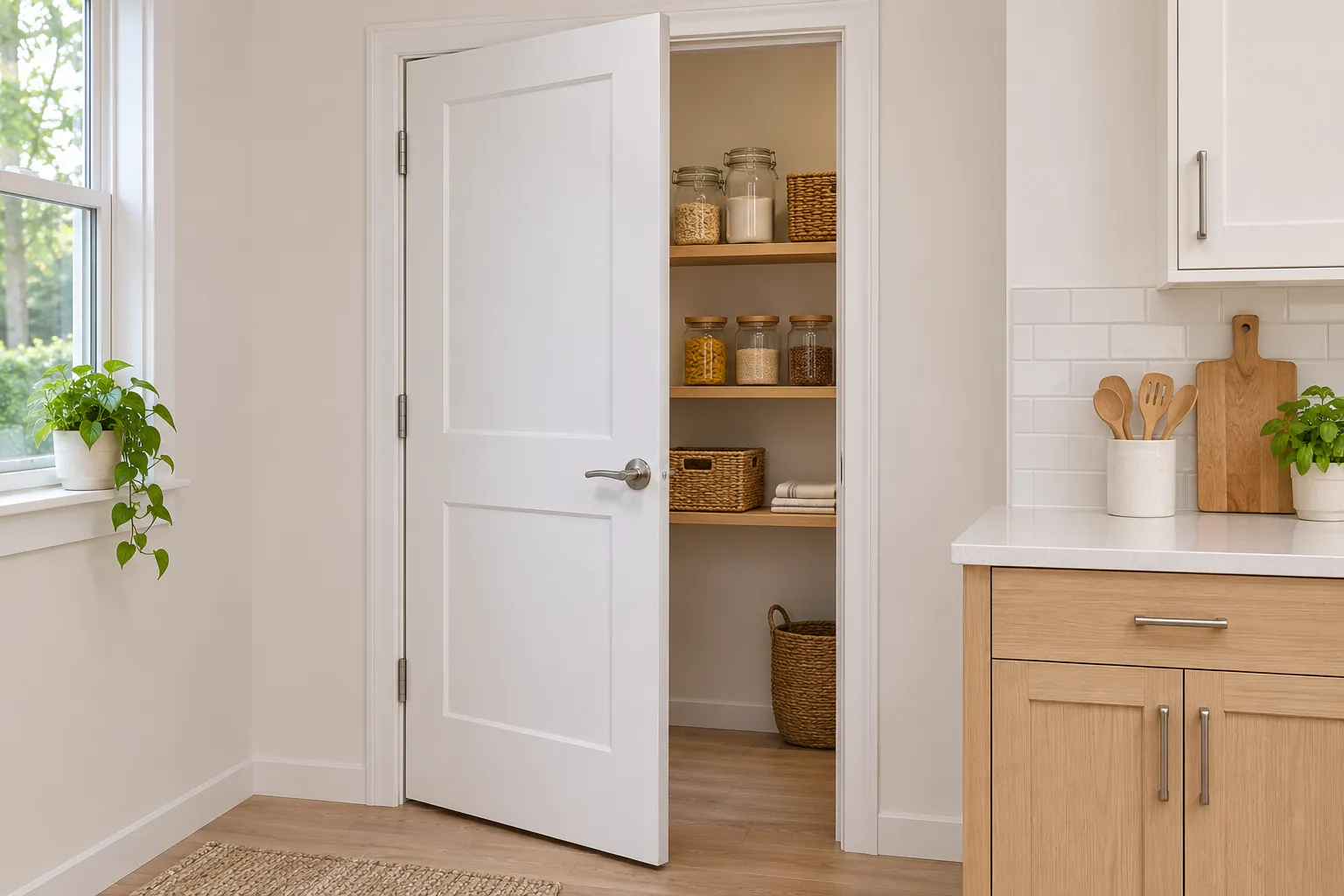
Choose a pantry door by checking how it works while the kitchen is in use. A simple hinged door may be the most practical option when its swing is clear. Consider a bifold or pocket system only when it solves a measured conflict with traffic, appliances or storage access.
A pantry is opened with full hands, sometimes several times during one meal. A panel that looks discreet when closed can become an obstacle once a dishwasher is open or someone is working at the counter.
Walk through an ordinary kitchen task
Imagine unloading groceries, collecting ingredients and putting a large appliance away. Open the surrounding drawers and cabinet doors, and stand in the kitchen's usual walking route. Then mark where the pantry panel would be at each stage of its movement.
Check the inside too. A door that clears the kitchen may swing into a shelf or make the lowest storage harder to reach. If the pantry has pullouts, test their full travel with the proposed door open.
Compare pantry door styles
| Style | When it may help | What can get in the way |
|---|---|---|
| Hinged | A straightforward opening with room for the swing | A nearby counter, appliance or internal shelf |
| Bifold | A full-width hinged panel projects too far into the kitchen | The folded stack and its hardware still take space |
| A swing area needs to stay clear and the wall is suitable | Wall services, framing and access for future maintenance | |
| Wall-mounted sliding | There is a clear wall run beside the opening | Switches, wall storage, trim and the parked panel |
| Bypass sliding | A wider pantry opening can tolerate partial access | A panel remains in front of part of the storage |
These options solve different problems. A pocket door uses the wall cavity; a wall-mounted slider uses the face of the wall. Neither should be specified by looking only at the pantry opening.
Choose the finish around actual use
Think about hands, food preparation and cleaning rather than choosing a finish solely from a color sample. Ask the manufacturer how the product should be finished and cleaned. A primed door may still require additional finishing; use the exact instructions for the selected product.
Opaque doors conceal mixed packaging and everyday clutter. Glass can make stored items part of the kitchen's appearance, which may or may not suit how the pantry is used. Confirm the complete glazed-door specification and applicable safety requirements rather than adding unspecified glass to a panel.
Check handles, catches and opening effort
A handle should be reachable without colliding with a counter or cabinet. Check whether the door needs a latch, catch or a particular sliding-door pull. Hardware preparation varies, so a handle selected late can create an avoidable compatibility problem.
Consider who uses the pantry. An easy-to-reach pull and a clear route may matter more than a decorative mechanism. Do not assume that a heavier panel or soft-close label automatically means the opening is easier to use; verify the behavior of the complete system.
A useful ordering checklist
- Measure the finished opening and record the floor finish.
- Draw nearby appliances, drawers, handles and counters.
- Show both the closed and fully open panel positions.
- Check shelf and pullout access behind the doors.
- Confirm the selected panel's compatibility with its track, hinges or pivots.
- Read finishing and installation instructions before ordering.
Do not assume a pantry door is airtight or a food-pest barrier. If you are dealing with pests or dampness, address the underlying storage and building conditions rather than relying on the decorative door as a remedy.
For a tight layout, our small-kitchen pantry door guide starts with the specific places where doors and kitchen tasks collide.
Sources and methodology
- Johnson Hardware: pocket door hardware — Product families for panels that slide into a wall cavity.
- Johnson Hardware: bi-folding hardware — Folding hardware options and product requirements.
- Johnson Hardware: installation instructions — System-specific dimensions, weights and fitting instructions.
- Masonite: professional resources — Finishing and care documents for the manufacturer’s door products.
This is a desk-researched comparison of materials and layout choices, not a hands-on product test. Manufacturer guidance applies to the products and assemblies it describes. Our room recommendations are editorial judgments; confirm the specifications and installation instructions for the exact door and hardware you choose.