
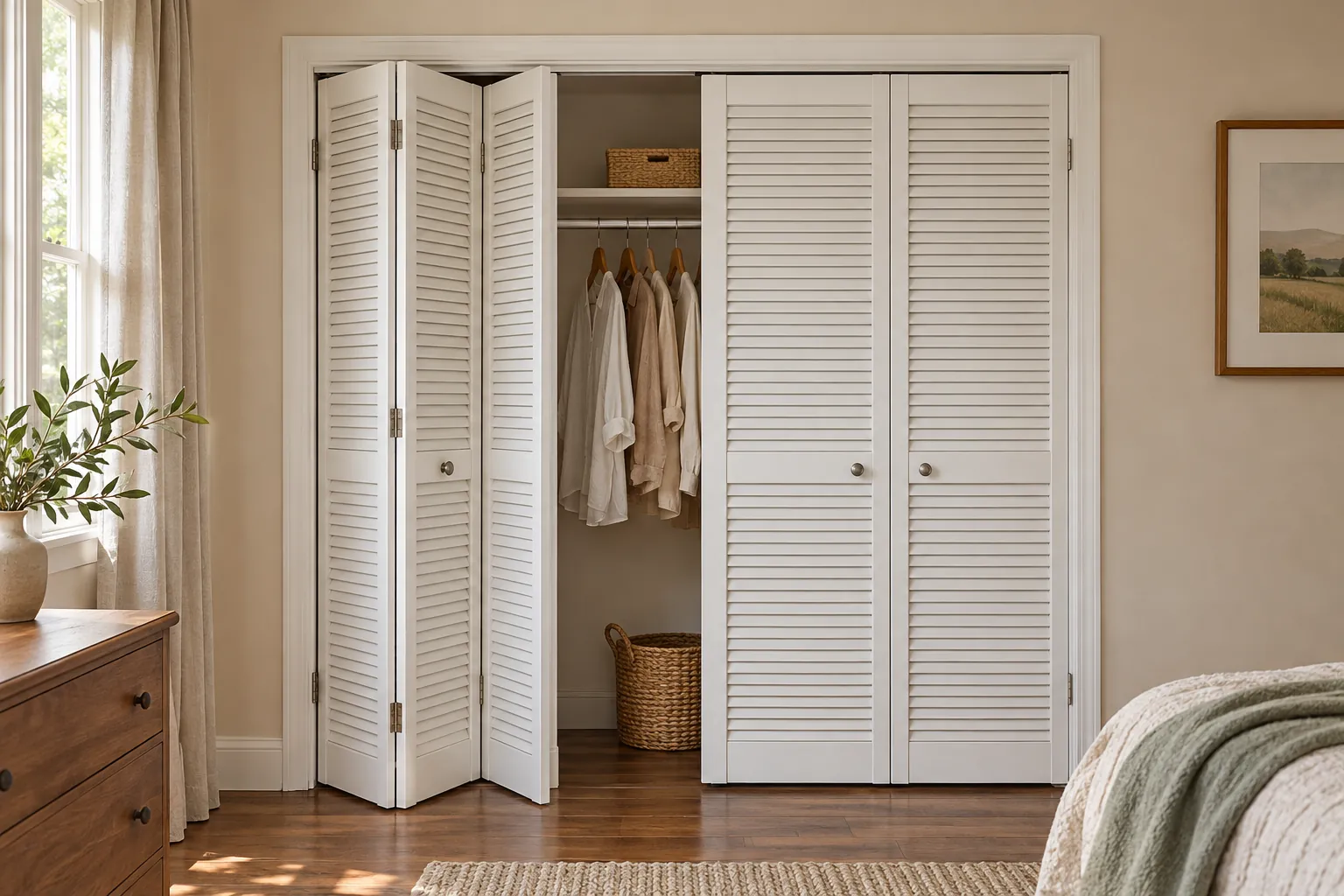
Quick answer
Bifold doors fold toward the sides of an opening and project into the room. Bypass sliding doors move past one another and leave part of the opening covered. Choose bifolds when their folded stack still leaves useful storage access; consider bypass sliders when avoiding a swing matters more than exposing the full closet at once.
In this comparison, sliding means overlapping bypass panels. Pocket doors and wall-mounted sliders use different arrangements and should be assessed separately.
Compare the movement, not just the closed appearance
A closed set of bifolds can look much like another paneled door arrangement. Once open, its hinged panels form a stack. That stack takes up physical space at the side and in front of the opening.
With bypass sliders, one panel moves in front of or behind another. There is no conventional hinged sweep, but a panel stays across part of the storage. The exact usable opening depends on the number of panels, track arrangement and hardware design.
| Decision point | Bifold doors | Bypass sliding doors |
|---|---|---|
| Space in front | Folded panels project outward | Panels move along the opening |
| Access behind the panels | Stacks occupy part of the opening | Overlapping panels cover part of the storage |
| Nearby furniture | Check both swing and folded position | Check handles, guides and the approach to the closet |
| Internal drawers | Confirm that stacks clear the drawer travel | Confirm that a parked panel does not block the drawer |
| Replacement work | Requires compatible pivots, track and panel preparation | Requires compatible tracks, guides, panel overlap and preparation |
Do not use a fixed percentage of access for every system. Read the chosen product's drawings and test its open position against the storage layout.
When bifolds are worth considering
Bifolds are worth comparing when you want access across a closet and can accommodate the folded panels. Check the ends of shelves, the first and last hanging sections, and any drawer closest to a jamb.
Consider the operating sequence as well. Can the user reach and move the panels comfortably? Are there spots where fingers or clothing could get caught? Follow the chosen hardware instructions for stops, pivots and adjustment rather than improvising a setup from unrelated parts.
When bypass sliders are worth considering
Bypass doors are worth comparing when a bed or another obstruction makes a hinged sweep inconvenient. They may suit storage that is normally used one section at a time.
They are less convenient if you frequently need a wider uninterrupted opening for bins, equipment or internal pullouts. Move the proposed panels on a scale sketch and confirm that each frequently used section can be reached without an awkward sequence.
Check the opening and hardware together
Johnson Hardware publishes distinct instructions for folding and bypass systems. Hardware capacities, panel preparation, clearances and supports vary by product. Match the panel's size and weight to the specified system rather than selecting a track based only on its length.
An existing dragging or jumping door may have an alignment, guide, track or support problem. Before replacing the panels, inspect the frame and record the floor level. A change to flooring can affect the available clearance and the installation scope.
Measure for the system you will actually order
Record the finished opening at several positions and identify the instructions the supplier uses for that specific product. Do not subtract a generic allowance from the opening and assume every door will fit.
Write down the usable opening in the fully open position, the furthest panel projection and any storage item that must pass through it. Those three observations often make the practical choice clearer than a style comparison alone.
Return to our closet door guide for other opening styles. If the same decision is being made for food storage, the pantry door guide adds kitchen traffic and appliance conflicts.
Sources and methodology
- Johnson Hardware: bi-folding door hardware — Examples of folding systems and compatible components.
- Johnson Hardware: sliding bypass hardware — Examples of overlapping sliding systems.
- Johnson Hardware: installation instructions — Separate folding and sliding instructions; product-specific clearances and preparation.
This is a desk-researched comparison of materials and layout choices, not a hands-on product test. Manufacturer guidance applies to the products and assemblies it describes. Our room recommendations are editorial judgments; confirm the specifications and installation instructions for the exact door and hardware you choose.