
Quick answer
Choose the opening style around the room's layout, then choose the door's construction around privacy, sound and everyday use. A bedroom often deserves more attention to sound control than a storage closet. A cramped kitchen may benefit more from a different opening mechanism than a heavier panel. There is no single interior door that is best for every opening.
Start by naming the problem you want the new door to solve. If the existing door catches on the floor, a replacement panel alone may not fix the frame or clearance problem. If a room feels noisy, construction matters, but so do the gaps around the opening.
A starting point for each room
| Room | First priority | Options worth comparing | Main check |
|---|---|---|---|
| Bedroom | Privacy and manageable noise | Hinged solid-core door; an appropriately specified acoustic assembly when needed | Frame, seals and door-bottom clearance |
| Bathroom | Privacy and reliable operation in humid conditions | A properly finished hinged door; a suitable pocket system when swing space is tight | Ventilation, latch operation and moisture exposure |
| Closet | Useful access to storage | Bifold, bypass sliding or hinged doors | What each panel blocks when open |
| Pantry | Access without interrupting the kitchen | Hinged, bifold or pocket doors | Conflicts with drawers, appliances and the walking route |
These are starting points for planning, not product rankings. A door that suits one house may be impractical in another because of the wall, existing frame or way the room is used.
Choose construction separately from appearance
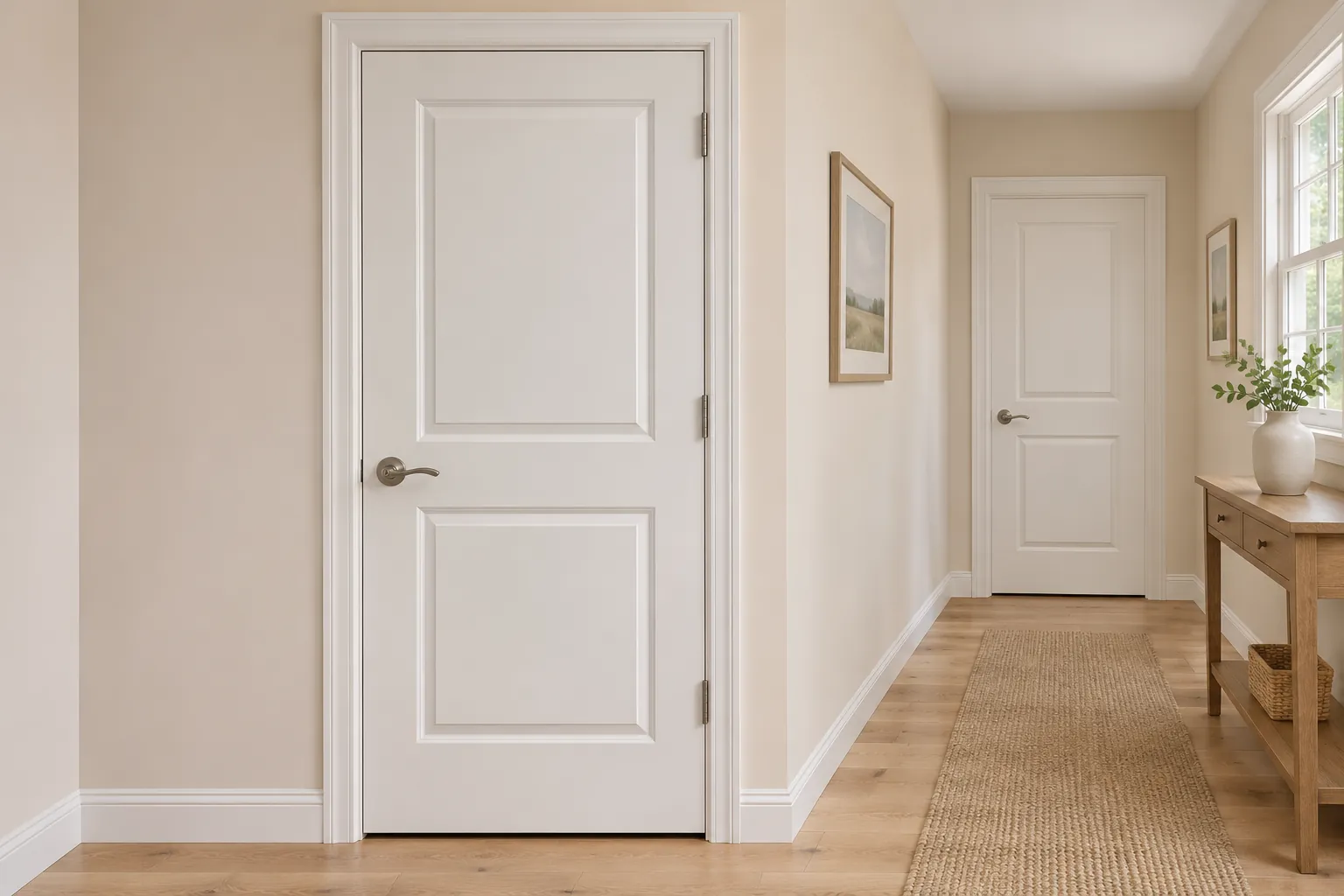
A paneled face does not tell you what is inside the door. Similar-looking doors may have different cores, weights and hardware requirements. Solid-core does not necessarily mean solid lumber; check the manufacturer’s construction description.
Masonite describes its solid-core doors as denser and heavier than its standard hollow-core options. That is useful context, not a guarantee that every solid-core product has the same performance. For a sound-sensitive room, ask for evidence about the complete assembly. Our solid-core versus hollow-core comparison explains the distinction.
Check how the door moves
A hinged door needs a clear swing area. A pocket door moves into the wall, which makes the wall cavity part of the project. A wall-mounted sliding door needs an unobstructed stretch of wall. Bifold panels fold into a stack; bypass panels overlap and leave part of the opening covered.
Tape the proposed movement onto the floor before choosing a style. Open adjacent drawers, cupboards and appliance doors while standing in the route you normally use. Look at the opening from both sides. A space-saving door should make a real daily task easier, not simply look compact in a photograph.
Decide whether you need a slab or a prehung unit
A slab is the door panel. A prehung unit includes a door fitted to its frame. Reusing a sound frame may be reasonable, but matching a new slab means checking hinge positions, thickness, latch preparation and the existing frame's condition. A new panel is not automatically a drop-in replacement.
Ask what is included in any proposal: removal, the panel, frame, hardware, trim work, finishing and disposal. Compare the same scope instead of comparing a bare slab with a complete installation. This guide does not provide a local price estimate.
Make a short buying checklist
- Record the opening, current panel, frame condition and finished floor level.
- Decide what matters most: privacy, sound, access or swing clearance.
- Confirm that the chosen hardware supports the panel's size and weight.
- Read the exact product's finishing and trimming instructions.
- Check whether the opening has building, fire-safety or ventilation requirements before changing it.
Begin with the relevant bedroom, bathroom, closet or pantry door guide. Keep a door that already works well on your shortlist: replacing every opening with the same construction is not necessary to make a thoughtful room-by-room choice.
Sources and methodology
- Masonite: solid-core doors — Manufacturer description of construction, weight and intended sound-management benefits.
- Johnson Hardware: installation instructions — Product-specific requirements for sliding, folding and pocket systems.
- EPA: A Brief Guide to Mold, Moisture and Your Home — Why moisture control matters in rooms with recurring condensation.
This is a desk-researched comparison of materials and layout choices, not a hands-on product test. Manufacturer guidance applies to the products and assemblies it describes. Our room recommendations are editorial judgments; confirm the specifications and installation instructions for the exact door and hardware you choose.