
Quick answer
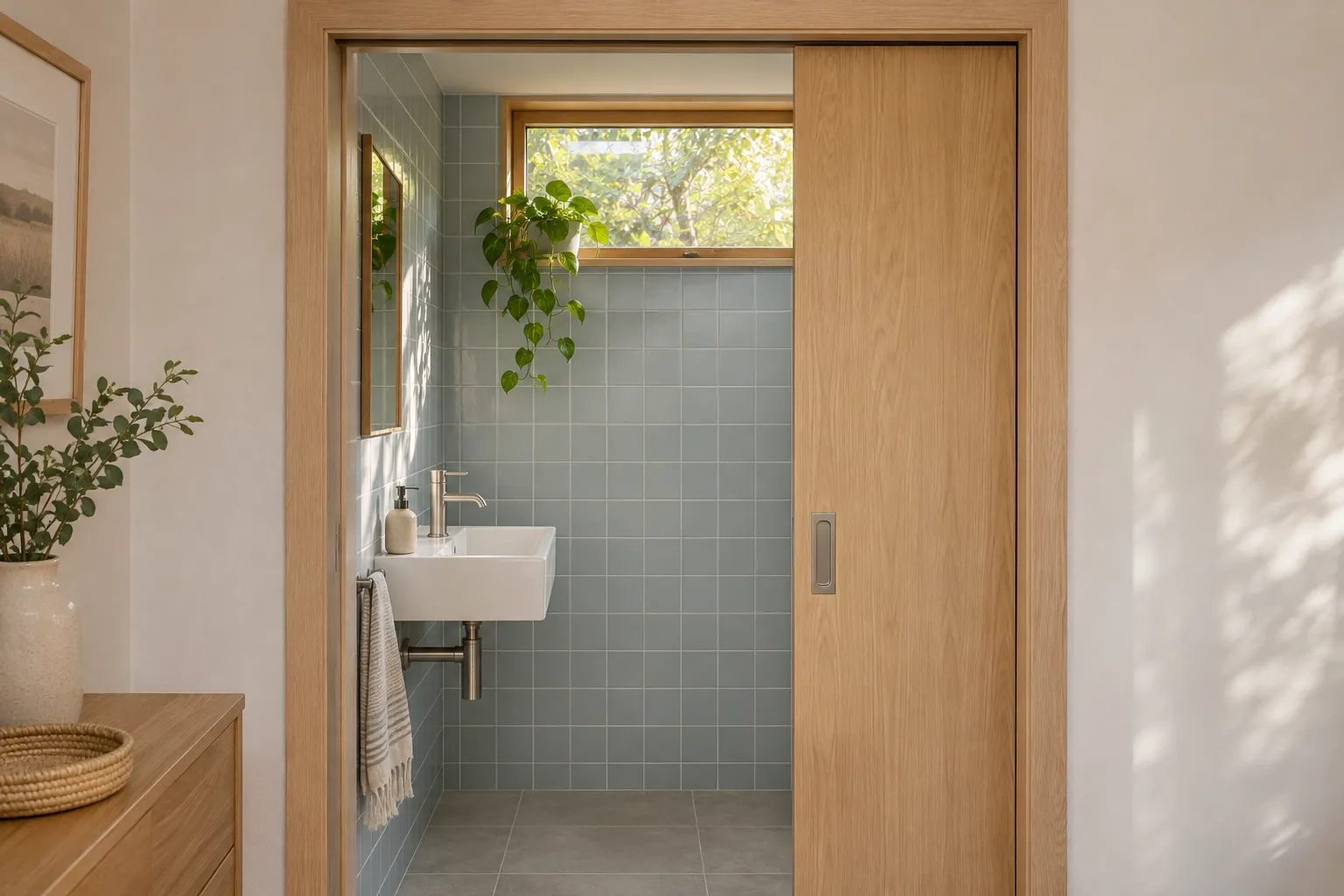
The best door for a small bathroom is the one that solves the actual layout conflict while preserving privacy and useful access. Keep a conventional hinged door on the shortlist if its swing can work. A pocket system can remove the swing area, but only where the wall and installation conditions suit it.
Do not choose a space-saving label before measuring the space you need to save. A panel that avoids one fixture may create a problem in the hall or reduce the usable opening.
Draw the conflict before changing the door
Sketch the bathroom and the approach outside it. Include the basin, toilet, shower screen, cupboards and handles. Mark the door fully open, partly open and closed. Check where a person stands to operate it.
Then act out a normal sequence: enter, close the door, use the room, wash hands and leave. Include any mobility equipment or assistance that the actual users need. A clear floor plan on paper is not enough if the handle cannot be reached comfortably.
Compare four common approaches
| Approach | Potential benefit | Main tradeoff |
|---|---|---|
| Retain a hinged door | Familiar latch and operating pattern | Needs a clear swing area |
| Pocket door | Keeps a hinged sweep out of the room | Requires a suitable wall cavity and compatible frame |
| Bifold door | Reduces the sweep of a single full-width panel | Folded panels still project and affect the clear opening |
| Wall-mounted slider | Avoids the room's swing area | Needs a clear wall run and a suitable privacy arrangement |
Reversing a swing is not a universal solution. An outward-opening panel can conflict with circulation or another door. Check the full setting and applicable local requirements before changing the handing or opening arrangement.
Check the wall before choosing a pocket system
A pocket frame occupies space within the wall. Existing services, framing and adjoining details can affect whether that is feasible. A supplier's product dimensions do not establish that a particular wall is suitable.
Johnson Hardware provides different pocket-frame systems and separate installation instructions. Match the frame, panel and hardware to the actual wall construction. Ask how the track and serviceable components can be accessed later, especially where finishes or cabinetry complicate the opening.
Make privacy a separate decision
A small bathroom still needs the privacy expected by its users. Check closed-panel sightlines, edge clearances and the actual latch arrangement. A surface-mounted slider is not automatically equivalent to a hinged privacy door.
If glazing is proposed, evaluate the specific glass and lighting conditions. An obscured appearance does not necessarily prevent visible silhouettes. Confirm the applicable safety specification with the supplier and any relevant local requirements.
Solve moisture problems alongside the layout
A different opening mechanism will not correct persistent condensation or a leak. The EPA's moisture guidance emphasizes addressing the water or moisture source. Choose a door and finish approved for the expected conditions and follow the manufacturer’s care requirements.
Keep planned ventilation routes in mind if the installation changes the panel's bottom clearance. A tighter-looking fit is not automatically a better fit for the room's airflow design.
Decide with a short checklist
Reject any option that blocks a fixture, makes the handle hard to reach or moves the conflict into a busy circulation route. For the remaining options, compare installation scope, usable opening, privacy hardware, maintenance access and finishing requirements.
A well-adjusted existing hinged door may be preferable to a more complex conversion that offers little practical benefit. Use our bathroom door overview for the wider privacy and moisture questions before choosing the final panel.
Sources and methodology
- Johnson Hardware: pocket door hardware — Different pocket systems require matching frames and hardware.
- Johnson Hardware: installation instructions — Product-specific dimensions and installation details.
- EPA: A Brief Guide to Mold, Moisture and Your Home — Moisture-source control and condensation guidance.
- Schlage: manuals and templates — Instructions for the exact chosen privacy mechanism.
This is a desk-researched comparison of materials and layout choices, not a hands-on product test. Manufacturer guidance applies to the products and assemblies it describes. Our room recommendations are editorial judgments; confirm the specifications and installation instructions for the exact door and hardware you choose.